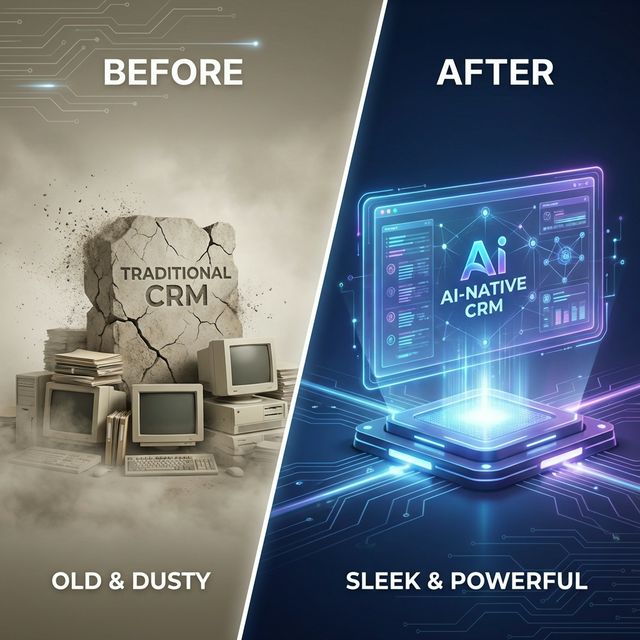
The AI CRM Revolution: Why Traditional CRMs Are Becoming Obsolete
For two decades, CRM software has followed the same basic pattern: humans enter data, software stores it, and reports tell you what happened. The strategic work—analyzing deals, crafting proposals, predicting outcomes—remains firmly on human shoulders.
That era is ending.
AI-native CRMs like Force CRM represent a fundamental shift: from passive databases to active partners in revenue generation. This isn't about adding AI features to existing software. It's about reimagining what CRM can be.
The Traditional CRM Model
Let's be honest about what most CRMs actually do:
What They Promise
- "360-degree customer view"
- "Streamlined sales processes"
- "Data-driven decision making"
- "Improved collaboration"
What They Deliver
- A database where salespeople reluctantly log activities
- Reports nobody has time to read
- Dashboards that show what already happened
- Another system to maintain
The Core Problem
Traditional CRMs are fundamentally passive. They wait for humans to:
- Enter contact information
- Log calls and meetings
- Update deal stages
- Analyze pipeline health
- Generate forecasts
- Write proposals
- Identify at-risk deals
The software stores and reports. Humans do all the thinking.
The AI-Native Alternative
AI-native CRMs flip this model. Instead of humans serving the software, software serves the humans:
| Traditional CRM | AI-Native CRM |
|-----------------|---------------|
| You log activities | Activities logged automatically from email/calendar |
| You analyze pipeline | AI analyzes and highlights issues |
| You forecast outcomes | AI predicts with probability scores |
| You write proposals | AI generates drafts for review |
| You identify risks | AI alerts you to at-risk deals |
| You decide next steps | AI recommends actions |
The human role shifts from data entry and analysis to decision-making and relationship-building.
How AI Changes Each CRM Function
1. Contact Management
Traditional: You manually enter contact details, company information, and relationship history. AI-Native:- Contact info extracted from email signatures automatically
- Company data enriched from public sources
- Relationship strength calculated from communication patterns
- Key stakeholders identified from cc'd participants
2. Activity Logging
Traditional: "Did you log your calls?" becomes a management refrain. AI-Native:- Email threads automatically associated with deals
- Calendar meetings linked to opportunities
- Call summaries transcribed and analyzed
- No manual logging required
3. Pipeline Visibility
Traditional: You run reports to see pipeline status. Dashboards show current state. AI-Native:- Real-time pipeline with AI predictions per deal
- Anomaly detection highlights unusual patterns
- Trending analysis shows direction of travel
- Proactive alerts for deals needing attention
4. Forecasting
Traditional: Reps provide "best guess" forecasts based on gut feel. Accuracy varies wildly. AI-Native:- ML models predict close probability per deal
- Historical pattern matching improves accuracy
- Weighted pipeline calculated automatically
- Forecast vs. actual tracking for continuous improvement
5. Deal Strategy
Traditional: Sales managers manually review deals and offer coaching. AI-Native:- AI analyzes engagement patterns and sentiment
- Identifies what's working in won deals
- Suggests approaches based on similar past situations
- Flags missing stakeholders or stalled engagement
6. Proposal Generation
Traditional: Reps spend hours in PowerPoint creating custom proposals. AI-Native:- AI generates proposal drafts from deal context
- Automatically includes relevant case studies
- Pricing recommendations based on similar deals
- One-click generation, human review and polish
The Data Advantage
AI-native CRMs have a significant advantage: they can actually use data.
Traditional CRMs Have Data Problems
- Incomplete: Reps don't log everything
- Inaccurate: Manual entry introduces errors
- Stale: Updates happen days after events
- Siloed: Email, calendar, documents separate from CRM
AI-Native CRMs Solve This
- Automatic capture: Data flows in without manual entry
- Consistent: AI processes don't forget or make typos
- Real-time: Analysis happens as events occur
- Integrated: Email, calendar, documents connected natively
With clean, complete, current data, AI can actually deliver on the "data-driven" promise that traditional CRMs made but couldn't keep.
What AI-Powered Sales Looks Like
Morning Pipeline Review
Traditional: Open CRM. Run pipeline report. Scan for issues. Check calendar. Open email. Cross-reference manually. AI-Native:Good morning! Here's your pipeline summary:
>
Needs Attention Today:
- 🔴 Acme Corp: Champion hasn't responded in 8 days. Suggest LinkedIn re-engagement.
- 🟡 GlobalTech: Proposal opened 3x yesterday but no response. Follow up today.
- 🟢 StartupX: All signals positive. Contract ready to send.
>
This Week's Priorities:
- 3 deals worth £180K in closing stage
- 2 new discovery calls scheduled
- 1 proposal due Thursday
Deal Research
Traditional: Google the company. Check LinkedIn. Search for news. Review past emails. Build your own picture. AI-Native:Acme Corp Deal Brief
>
Company: Enterprise software, 450 employees, £50M revenue
Recent News: Just raised Series C, expanding to Europe
Key Stakeholders:
- Sarah (VP Sales) - your champion, engaged
- Mike (CFO) - cc'd but hasn't engaged directly
- Janet (CEO) - no contact yet
>
Competitive Intel: Using competitor X, contract expires Q2
Recommended Approach: Engage CFO directly on ROI messaging
Proposal Creation
Traditional: Open PowerPoint. Copy from last proposal. Customize. Add pricing. Format. Review. Repeat for 2-3 hours. AI-Native:Proposal Generated for Acme Corp
>
Based on your discovery conversations, I've created a proposal highlighting:
- Sales efficiency (their stated priority)
- European expansion support (relevant given news)
- ROI case study from similar company (£2M ARR, SaaS)
>
Pricing: £45,000/year (based on similar deal analysis)
>
[Preview] [Edit] [Send]
Weekly Forecast
Traditional: "What's your forecast for the quarter?" Reps guess. Manager adjusts. Everyone knows it's fiction. AI-Native:Q1 Forecast Analysis
>
| Category | Amount | AI Confidence |
|----------|--------|---------------|
| Commit | £320K | 89% likely |
| Best Case | £485K | 67% likely |
| Pipeline | £890K | 34% weighted |
>
Risks:
- Acme Corp (£45K) shows declining engagement
- GlobalTech (£120K) decision-maker change detected
>
Upside:
- 3 deals moving faster than typical cycle
The Force CRM Approach
Force CRM implements AI-native CRM through four specialized agents:
CRO Agent (Chief Revenue Officer)
- Revenue strategy and optimization
- Pricing recommendations
- Deal structure suggestions
- Revenue forecasting
CSO Agent (Chief Sales Officer)
- Sales process optimization
- Rep performance insights
- Win/loss analysis
- Coaching recommendations
Quote Proposal Agent
- Automated proposal generation
- Pricing optimization
- Document creation
- Template management
AI SDR (Sales Development Representative)
- Lead qualification
- Initial outreach
- Objection handling
- Handoff to human reps
These agents work continuously, not just when you ask questions.
Objections and Responses
"Our sales team won't trust AI recommendations"
The AI shows its reasoning for every recommendation. Reps can see why a deal is flagged at-risk or why a particular approach is suggested. Transparency builds trust. And ultimately, reps are free to ignore recommendations—the AI learns from what works.
"We've invested heavily in Salesforce/HubSpot"
Force CRM can sync with existing CRMs. Many teams use Force CRM as an AI layer on top of their existing system. Start with AI-powered insights while keeping your system of record.
"AI can't understand our complex sales process"
AI learns from your specific patterns. The models improve based on your deals, your market, your team. After 90 days, Force CRM understands your business deeply.
"What about data security?"
Customer data is encrypted at rest and in transit. We don't train on customer data. Enterprise tier includes data residency options.
The Transition Path
Moving from traditional to AI-native CRM doesn't have to be disruptive:
Phase 1: Augmentation (Month 1-2)
- Connect Force CRM to email and calendar
- Import historical deal data
- Let AI learn your patterns
- Keep using existing CRM for logging
Phase 2: Adoption (Month 3-4)
- Start using AI-generated insights daily
- Let AI draft proposals (human reviews)
- Use AI forecasts alongside traditional ones
- Reduce manual data entry
Phase 3: Transformation (Month 5+)
- AI handles routine tasks automatically
- Reps focus on relationships and strategy
- Management uses AI forecasts as primary
- Retire redundant processes
Measuring Success
How do you know if AI CRM is working?
| Metric | Traditional | AI-Native Impact |
|--------|-------------|------------------|
| Time spent on admin | 30%+ of day | Reduced to <10% |
| Forecast accuracy | 60-70% | 85%+ |
| Pipeline visibility | Lagging | Real-time |
| Proposal creation time | 2-3 hours | 10 minutes |
| Deal insights | Reactive | Proactive |
The Future of CRM
The trajectory is clear:
Short-term (1-2 years):- AI augments human decision-making
- Manual data entry becomes optional
- Forecasting accuracy dramatically improves
- AI handles routine sales tasks autonomously
- Human reps focus on complex relationships
- CRM becomes truly predictive, not just reactive
- AI and human sales teams collaborate seamlessly
- Personalization at scale becomes standard
- "CRM" as a category may disappear into something new
Getting Started
Ready to experience AI-native CRM?
- Try Force CRM free at executiveforceai.com
- Import your historical data to let AI learn
- Connect email and calendar for automatic capture
- Use AI insights for 30 days and measure the difference
The future of CRM isn't about storing data better. It's about acting on it intelligently.
Force CRM is available in the Growth tier and above. Start your free trial →