Why SMEs Need AI Now: Enterprise Tools at Startup Prices
For the past decade, enterprise companies have had access to AI-powered tools that smaller businesses could only dream of:
- Predictive analytics that forecast sales and inventory
- Intelligent CRMs that score leads and recommend actions
- Strategic planning tools that model scenarios and optimize decisions
- Automated processes that eliminate manual work
Meanwhile, SMEs (small and medium enterprises) have been stuck with spreadsheets, gut feelings, and tools designed for the mass market.
That gap is closing—fast. And businesses that don't adapt will be left behind.
The Traditional Divide
What Enterprise Companies Have
Large companies invest millions in:
| Capability | What It Does | Typical Cost |
|------------|--------------|--------------|
| Business Intelligence | Dashboards, analytics, insights | £50K-500K/year |
| CRM + Sales Intelligence | Predictive scoring, recommendations | £100K-1M/year |
| Strategic Planning | Scenario modeling, optimization | £200K-2M/year |
| Process Automation | AI-powered workflows | £100K-500K/year |
| Data Science Team | Custom AI/ML development | £500K-2M/year |
Total: £1-5 million annually before you count the implementation costs and internal resources to manage it all.What SMEs Have Had
Smaller companies make do with:
| Need | Typical Solution | Limitations |
|------|------------------|-------------|
| Analytics | Spreadsheets | Manual, error-prone, time-consuming |
| CRM | Basic SaaS | Data storage, no intelligence |
| Planning | Gut feel + experience | Limited scalability, inconsistent |
| Processes | Manual labor | Expensive, slow, doesn't scale |
| Insights | Consultants (occasionally) | Expensive, not always available |
The gap isn't about capability—it's about resources. SMEs can't afford enterprise tools, can't hire data science teams, and don't have time to manage complex systems.
Why This Matters Now
The Competitive Pressure
Large companies are using AI to:
- Identify customers before SMEs even know they exist
- Optimize pricing to be competitive where it matters
- Predict and prevent churn before it happens
- Operate more efficiently on thinner margins
SMEs competing against these organizations are bringing a knife to a gunfight.
The Customer Expectation
Customers now expect:
- Personalized experiences (powered by AI)
- Instant responses (powered by automation)
- Accurate predictions (powered by data)
- Seamless service (powered by integration)
These expectations don't adjust based on company size.
The Talent Challenge
SMEs can't compete with enterprise salaries for:
- Data scientists (£70-150K)
- AI/ML engineers (£80-160K)
- Business analysts (£50-90K)
- Strategic consultants (£1-3K/day)
Without this talent, SMEs can't build their own AI capabilities.
What Changed: AI Economics
Three shifts have made enterprise-grade AI accessible to SMEs:
1. Cloud AI Services
Instead of building AI infrastructure, businesses can now access:
- Pre-trained models via APIs
- Managed AI services (no infrastructure needed)
- Pay-per-use pricing (no upfront investment)
2. Foundation Models (LLMs)
Large language models like GPT-4 and Gemini provide:
- General intelligence without custom training
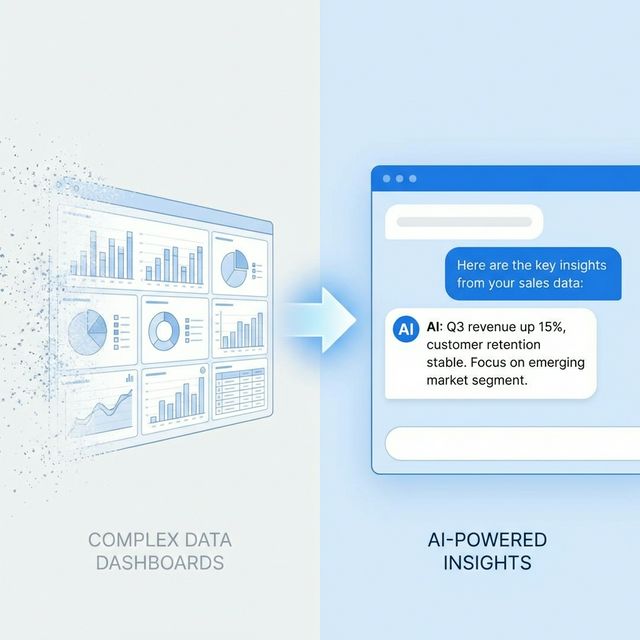
- Natural language interfaces (no technical skills needed)
- Broad knowledge applicable to many domains
3. Vertical AI Applications
Companies are now building AI-native business software:
- AI embedded, not bolted on
- Domain expertise built in
- Enterprise capabilities at SaaS prices
The New Economics
| Capability | Enterprise Build | SME Buy (2026) |
|------------|-----------------|----------------|
| AI-powered analytics | £500K/year | £200-500/month |
| Intelligent CRM | £100K-1M/year | £50-300/month |
| Strategic AI advisor | £200K/year+ | £100-300/month |
| Process automation | £100K/year+ | Built into tools |
| Implementation time | 6-18 months | Days-weeks |
The cost advantage of enterprise scale has collapsed.
What SMEs Should Prioritize
Not all AI capabilities are equally valuable. Here's where SMEs should focus:
High Priority
1. Customer IntelligenceUnderstanding customers better drives revenue:
- Lead scoring (which prospects are worth pursuing?)
- Churn prediction (who's about to leave?)
- Next-best-action (what should we do with this customer?)
AI can eliminate significant manual work:
- Document processing
- Data entry and categorization
- Routine communications
- Report generation
Better decisions have compounding returns:
- Market analysis
- Competitive intelligence
- Scenario planning
- Risk assessment
Lower Priority (for most SMEs)
- Cutting-edge ML research: Buy, don't build
- Custom model development: Use pre-built where possible
- AI for its own sake: Focus on business outcomes
The Sentient Suite Approach
We built the Sentient Suite specifically to bring enterprise AI to SMEs:
Affordable Pricing
Self-serve apps — EF-CRM and EF-CapFlow — are £29/month each, or £49/month together as the Business Duo, with a 7-day free trial. Enterprise apps (EF-Strategy, EF-Link, EF-Projex) are priced to fit your business after a free assessment.
Compare to £1-5 million annual enterprise spend.
No Technical Skills Required
- Natural language interfaces
- No SQL or coding needed
- Guided setup and onboarding
- Templates and best practices included
Full Enterprise Capabilities
Everything large companies have:
- An AI strategy advisor for multi-angle strategic analysis
- Predictive CRM with deal scoring
- Financial planning with AI CFO
- Supply chain optimization
- Autonomous project management
Built for UK Businesses
We understand UK-specific needs:
- HMRC and Companies House integration
- UK GAAP and VAT handling
- Pound sterling native
- EU/UK data residency
Case for Action
What You're Losing Today
Every day without AI-powered tools, you're:
- Missing opportunities: Leads going cold while you manually research
- Losing efficiency: Hours on tasks AI could do in seconds
- Making worse decisions: Gut feel vs. data-driven analysis
- Falling behind: Competitors gaining AI advantages
The Cost of Waiting
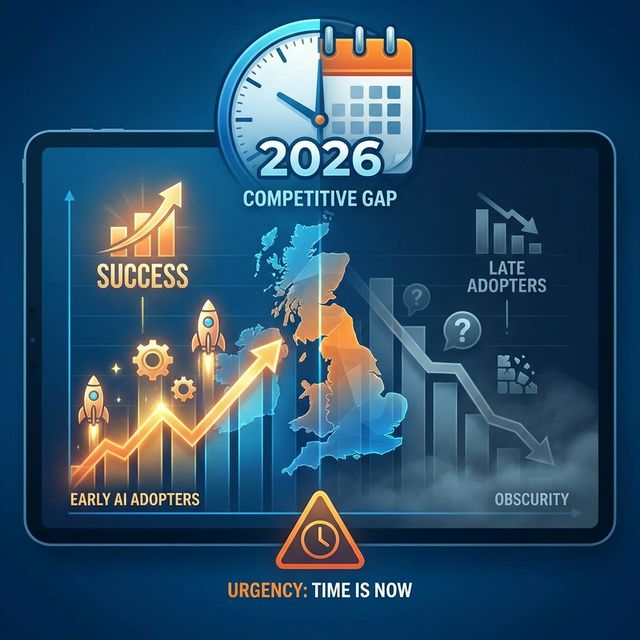
AI capabilities are compounding:
- Early adopters build data advantages
- Customer expectations keep rising
- Competitive gaps widen
- Catch-up costs increase
The best time to start was 2 years ago. The second-best time is now.
The Risk of Not Acting
Consider your competitive position in 5 years:
- If you adopt AI now: Learning curve complete, data advantages built, efficiency gains realized
- If you wait 3 years: Behind competitors, struggling to catch up, losing market position
AI isn't optional anymore. It's essential.
Getting Started
Step 1: Identify Your Biggest Pain Points
Where do you spend the most time on tasks that feel repetitive or analytical?
Common SME pain points:
- Sales pipeline management and forecasting
- Financial reporting and compliance
- Customer support and communication
- Project planning and resource allocation
- Strategic decision-making
Step 2: Start Small
Pick one area and prove value:
- Try Force AI for strategic questions
- Implement AI-powered CRM
- Automate financial categorization
- Use AI for project planning
Step 3: Measure and Expand
Track:
- Time saved
- Decisions improved
- Revenue impacted
- Customer satisfaction
Then expand to other areas.
Step 4: Build Organizational Capability
As you use AI more:
- Document what works
- Train your team
- Develop best practices
- Scale systematically
Common Objections
"AI is too expensive for us"
Self-serve apps start at £29/month—less than many basic SaaS tools. The question isn't whether you can afford AI; it's whether you can afford not to have it.
"We don't have the technical skills"
Our tools use natural language interfaces. If you can write an email, you can use Force AI. No coding, SQL, or data science required.
"Our data isn't ready"
Start with what you have. AI tools work with imperfect data and improve as you use them. Waiting for perfect data means waiting forever.
"We're too small for this"
The smallest businesses often benefit most from AI—they have the most to gain from efficiency improvements and can't afford dedicated specialists.
"I don't trust AI"
Our tools show their reasoning and let you approve decisions. You maintain control. AI suggests; you decide.
The Bottom Line
Enterprise AI is no longer enterprise-only. The economics have shifted, the technology is accessible, and the competitive pressure is real.
SMEs that embrace AI now will:
- Operate more efficiently
- Make better decisions
- Compete more effectively
- Grow faster
Those that wait will find themselves competing against AI-powered businesses with the tools of the past.
The gap is closing. Make sure you're on the right side of it.
The Sentient Suite brings enterprise AI to growing businesses. Start your free trial →