Why 56% of CEOs See Zero ROI from AI (And How to Be in the Other 44%)
Published: January 2026 Reading time: 5 minutesPwC's Global CEO Survey dropped this week, and the headline is brutal:
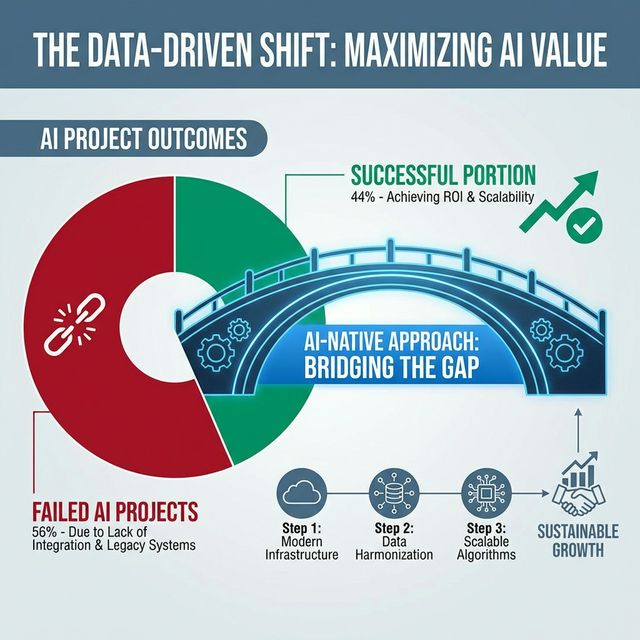
56% of CEOs say AI has delivered zero significant financial benefit.Not "disappointing returns." Not "slower than expected." Zero.
MIT's research is even worse: 95% of organizations reported zero return on generative AI investments last year.
After years of breathless AI hype and billions in enterprise spending, most companies have nothing to show for it.
I'm not surprised. And if you're paying attention, you shouldn't be either.
The Real Problem: Spending Before Understanding
Here's the uncomfortable truth that nobody in the AI industry wants to admit:
Most companies overspend on AI before they understand what they actually need.The logic typically goes like this:
- "AI is transformative"
- "Therefore we need AI"
- "Therefore we'll be more efficient"
- "Therefore we'll save money"
That reasoning is backwards. And expensive.
The PwC survey found something fascinating buried in the data: CEOs whose organizations established "AI foundations" first—like responsible AI frameworks and technology environments enabling enterprise-wide integration—were three times more likely to report meaningful financial returns.
Three times.
The difference isn't budget size. It's preparation.
The ChatGPT Illusion
One CEO in the survey put it perfectly:
"ChatGPT was just suddenly there and people could use it on a consumer basis, and everybody thought, 'this is easy'. But challenges then emerged around how you use it on an organizational scale for bespoke business models."
This is the heart of the problem.
ChatGPT is brilliant for individual productivity. Ask it to write an email, summarize a document, explain a concept—magic.
But then companies thought: "Let's just roll this out to everyone and watch efficiency soar!"
Except:
- ChatGPT doesn't know your business processes
- It can't access your systems
- It doesn't understand your industry's compliance requirements
- It hallucinates confidently about things it doesn't know
- It can't actually DO anything—just talk about doing things
The gap between "AI assistant that chats" and "AI that runs business processes" is enormous. Most enterprises are stuck in that gap, burning money on pilots that never scale.
The Microsoft Word Analogy
Here's a thought experiment that puts the AI spending crisis in perspective:
Imagine a corporation deciding they need word processing software. Instead of buying Microsoft Office, they hire a team of developers to build their own version of Word and Excel from scratch.
You'd think they were insane.
"Just buy Office and configure it for your workflows! It's proven, it's tested, it works. Why would you spend two years and £2 million reinventing the wheel?"
But that's exactly what companies are doing with AI.They're spending millions on custom AI development—hiring consultants, building bespoke models, creating proprietary infrastructure—when proven, configurable AI solutions already exist.
Two years and several million pounds later, they've got a prototype that barely works. Meanwhile, their competitors bought pre-built AI tools, configured them for their business in weeks, and moved on to actually using them.
The parallel is exact:
| Office Software | AI Software |
|-----------------|-------------|
| Buy Office, configure for your company | Buy proven AI tools, configure for your business |
| 2 weeks, £500/year | 2 weeks, £1,200/year |
| Build your own Word from scratch | Build custom AI from scratch |
| 2 years, £2 million, uncertain outcome | 2 years, £2 million, uncertain outcome |
The 56% seeing zero ROI? Many of them chose option two.
The Companies Getting It Right
So who are the 1-in-8 CEOs reporting both cost AND revenue benefits?
According to PwC, they share common traits:
1. They identified specific problems firstNot "let's use AI somewhere" but "invoice processing takes 4 hours per day and costs us £X annually."
2. They built foundations before buying toolsData quality. Process documentation. Integration architecture. The boring stuff that makes AI actually work.
3. They applied AI to products and customer experiencesPwC's separate analysis found companies applying AI to products and services achieved nearly four percentage points higher profit margins than those who didn't.
4. They started small and proved valuePilot → Measure → Scale. Not Pilot → Bigger Pilot → Even Bigger Pilot → "Why isn't this working?"
Before You Spend Big: A Checklist
If you're considering AI investment (or wondering why your current investments aren't paying off), ask yourself:
✅ Can you describe the problem in one sentence?
"We need AI" is not a problem statement.
"Our sales team spends 12 hours weekly on data entry instead of selling" is.
✅ Can you quantify the cost of the problem?
If you don't know what the problem costs you today, you can't measure whether AI solved it.
✅ Does the solution require AI, or just better software?
Sometimes the answer is a spreadsheet. Or a process change. Or hiring one more person. AI should solve problems that traditional software can't—not be a fancy replacement for tools that already work.
✅ Can you start with the smallest possible implementation?
The companies seeing ROI didn't sign seven-figure enterprise contracts on day one. They proved value with focused pilots, then expanded.
✅ Do you have the data and systems to support it?
AI needs clean data, clear processes, and integration points. If your data lives in 47 spreadsheets and everyone has their own way of doing things, fix that first.
The Uncomfortable Truth for AI Vendors
I'll say what most AI companies won't:
You probably don't need an "AI platform."You need solutions to specific problems.
The AI industry wants to sell you infrastructure, platforms, and enterprise licenses. They want the big contract and the press release.
But the PwC data shows that approach isn't working for most buyers.
What works? Purpose-built tools that solve specific problems at price points that don't require board approval.
Start with one problem. Prove value. Then expand.
The winners aren't spending the most. They're spending smart.
What This Means for 2026
PwC's global chairman, Mohamed Kande, put it starkly:
"2026 is shaping up as a decisive year for AI. A small group of companies are already turning AI into measurable financial returns, while many others are still struggling to move beyond pilots. That gap is starting to show up in confidence and competitiveness – and it will widen quickly for those that don't act."
The gap is widening. Fast.
If you're in the 56% seeing zero returns, this isn't the year to double down on what isn't working. It's the year to step back, identify what you actually need, and invest accordingly.
And if you haven't started yet? You have an advantage. You can skip the expensive mistakes and go straight to what works.
The Bottom Line
AI isn't magic. It's a tool.
Like any tool, it works brilliantly when applied to the right problem with proper preparation. And it's an expensive paperweight when it isn't.
Before you spend big, pinpoint your needs.
The 56% didn't fail because AI doesn't work.
They failed because they bought answers before they understood the questions.
Data sources: PwC Global CEO Survey (January 2026), MIT research on generative AI ROI
About the Author [Your name/bio here]
Related Articles
- The True Cost of Enterprise AI: What No One Tells You
- 5 Questions to Ask Before Any AI Investment
- Why Small Businesses Are Winning the AI Race
Want to discuss how AI can solve specific problems in your business without the enterprise price tag? Get in touch or explore Sentient Suite - purpose-built AI apps that prove value before you scale.